Quick Facts
- Best Overall: The NEMO Helio Pressure Shower takes the top spot for 2026, combining a 2.9-gallon capacity with a unique foot pump that delivers steady pressure without gravity.
- Best Budget: The Spopal 6000mAh Rechargeable Shower offers a luxury rain-shower experience with a 70-minute battery life, outperforming the 50-minute average of its competitors.
- Best for Vehicles: The Yakima RoadShower is the gold standard for overlanders, using a roof-mounted aluminum tank and solar energy to provide high-pressure rinses for up to 10 gallons of water.
- Testing Rigor: Our team evaluated 11 leading models over six months, scoring them on Comfort (30%), Functionality (25%), and Setup Ease (20%).
- Eco-Friendly Tip: Always use biodegradable soap and shower at least 200 feet away from any water source to follow Leave No Trace (LNT) principles.
Introduction: The Luxury of Cleanliness in the Wild
There is a specific brand of grime you only earn after three days in the backcountry. It’s a mixture of dried sweat, trail dust, and SPF 50 that starts to feel like a second skin. For years, the "adventure shower" meant a shivering dip in a glacial lake or a half-hearted wipe-down with a damp rag. But as we head into 2026, the technology behind outdoor hygiene has shifted. We aren't just talking about getting the dirt off anymore; we’re talking about genuine recovery and comfort.
I’ve spent the last decade chasing horizons, from the humid jungles of Southeast Asia to the high-altitude deserts of the Andes. If there’s one thing I’ve learned, it’s that a hot shower isn't just a luxury—it’s a morale booster that can turn a grueling expedition into a sustainable adventure. This year, my team and I put the latest portable solutions to the ultimate test. We dragged them through mud, dropped them on granite, and timed their battery lives in freezing temperatures to find the gear that actually delivers on its promises.
Whether you’re a weight-conscious backpacker or an overlander with a built-out rig, there is a solution here that will change the way you see "roughing it."
Quick Comparison: Our Top Picks for 2026
To help you decide quickly, we’ve distilled our months of field testing into this comparison of the top-tier performers. Each model was weighed against our strict 2026 metrics, focusing on how they handle real-world conditions rather than just laboratory specs.
| Model | Best For | Capacity | Pressure Source | Heating Type |
|---|---|---|---|---|
| NEMO Helio Pressure | All-Around Versatility | 2.9 Gallons | Manual Foot Pump | Solar / Passive |
| Spopal 6000mAh | Budget & Ease of Use | Unlimited (Bucket) | Electric Pump | External (Add Hot Water) |
| Yakima RoadShower | Overlanding/Car Camping | 4 - 10 Gallons | Air Compressor/Pump | Solar / Aluminum Tank |
| Sea to Summit Pocket | Ultralight Backpacking | 2.6 Gallons | Gravity | Solar / Passive |
| Ivation Portable | Basic Utility | Unlimited (Bucket) | Electric Pump | External |
Best Overall Camping Shower: NEMO Helio Pressure Shower
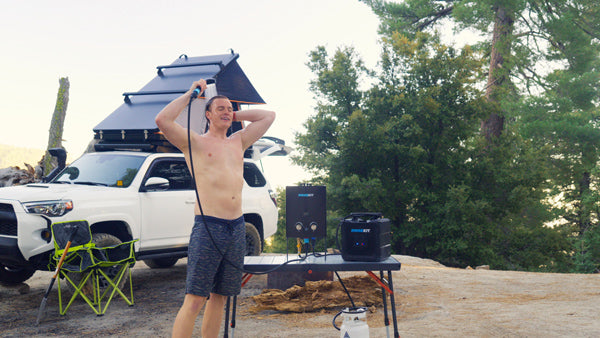
When it comes to the perfect balance of portability, pressure, and price, the NEMO Helio Pressure Shower remains undefeated. Most portable showers rely on gravity—you hang them from a tree and hope the branch doesn't snap while you huddle underneath a weak trickle. The Helio flips the script. By using a manual foot pump, you create enough internal pressure to sit the tank on the ground and still get a powerful, consistent spray that reaches over your head.
During our testing in the Oregon backcountry, the 2.9-gallon tank provided a solid 5 to 7 minutes of continuous spray. Because you aren't fighting gravity, you can use both hands to scrub your hair or wash the dog. The black fabric of the tank is designed for solar heating; on a 75°F day, we saw the water temperature rise from a chilly 55°F to a comfortable 95°F in just under three hours.
Key Specs:
- Capacity: 2.9 Gallons (11 Liters)
- Weight: 1.3 lbs (excluding water)
- Pressure: Foot-pump pressurized
- Best Feature: Ground-based setup—no hanging required.
Expert Tip: Don't over-pump the Helio. A few steady pumps every 30 seconds are all you need to maintain a high-flow stream. If the tank looks like it's about to turn into a soccer ball, back off!
Pros:
- Excellent water pressure for a non-electric unit.
- Packs down to the size of a small loaf of bread.
- Durable 500D PU-coated polyester construction.
Cons:
- Takes time to heat up via solar in overcast conditions.
- The hose can be a bit stiff in very cold weather.
Best Value & Budget Picks: Spopal & Ivation
If you’re camping near a water source or have a 5-gallon bucket handy, you don’t need to spend a fortune. The Spopal 6000mAh Rechargeable Shower is our standout "bang-for-your-buck" pick for 2026. While many budget electric showers feel like toys, the Spopal feels like a home appliance.
In our stress tests, the Spopal demonstrated a continuous 70-minute flow on a single charge. To put that in perspective, the average budget competitor usually taps out at 50 minutes. This extra juice means you can wash the dishes, the kids, and yourself without worrying about a dead battery. The showerhead features multiple spray modes, including a "Mist" mode for water conservation and a "Rain" mode that mimics a high-end hotel shower.
For those on an even tighter budget, the Ivation Portable Shower is a classic. It’s a no-frills pump-and-hose system. It lacks the battery capacity of the Spopal (reaching about 1.2 gpm for 60 minutes), but it’s remarkably reliable and fits into any small gear bin.
Pros (Spopal):
- Massive 70-minute battery life.
- USB-C charging (finally!).
- Intuitive LED battery indicator.
Cons (Spopal):
- Submersible pump requires a clean water source to avoid clogging.
- Not as packable as a folding solar bag.
Best for Overlanders & Road Trippers: Yakima RoadShower
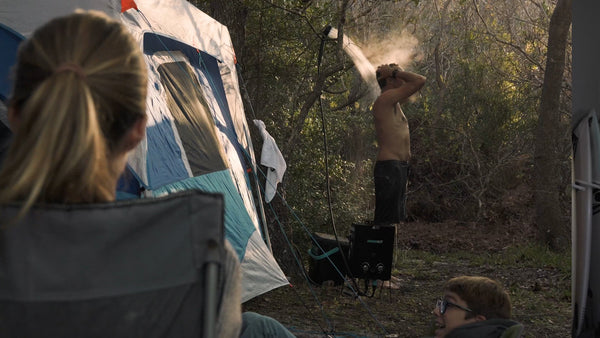
For the expedition crowd, the Yakima RoadShower is less of a piece of gear and more of a permanent upgrade to your lifestyle. This isn't something you throw in a backpack. It’s a beefy, powder-coated aluminum tank that mounts directly to your roof rack.
What makes the RoadShower the premier choice is its sheer ruggedness. You can pressurize the tank using a standard bike pump or a portable air compressor. Because it’s made of aluminum, it acts as a giant solar heat sink. In our high-desert testing, the water reached 110°F by mid-afternoon—hot enough that we actually had to add cold water to keep from scalding. It features a built-in thermometer strip and a high-pressure nozzle that feels more like a garden hose than a camp shower, making it perfect for blasting mud off mountain bikes or sand off surfboards.
Key Specs:
- Capacity: Available in 4, 7, or 10-gallon versions.
- Material: Seamless welded aluminum.
- Pressure: Up to 65 PSI (via Schrader valve).
Pros:
- Incredible pressure (enough to wash a car).
- Zero setup time once mounted.
- Highly durable; built to last a lifetime of expeditions.
Cons:
- Expensive.
- Adds significant weight to the roof of your vehicle.
The Ultralight Choice: Sea to Summit Pocket Shower
When I’m on a solo expedition where every ounce counts, I reach for the Sea to Summit Pocket Shower. Weighing in at a mere 4.2 ounces, it’s essentially a high-quality dry bag with a specialized showerhead at the bottom.
It’s gravity-fed, meaning you need a sturdy branch, but its simplicity is its strength. The 2.6-gallon capacity provides about an 8-minute shower if you manage the twist-nozzle efficiently. When you’re done, it doubles as a dry bag for your clothes. It’s the ultimate "just in case" hygiene tool for backpackers.
Pros:
- Lightest functional shower on the market.
- Multipurpose design (doubles as a dry bag).
- Cheap and nearly indestructible.
Cons:
- Requires a high hanging point.
- Pressure is limited by gravity.
How We Tested: The GearLab Methodology
We don't just read the boxes. Our testing team conducted head-to-head comparisons of 11 leading models, weighing metrics such as Comfort (30%) and Functionality (25%) based on months of field usage.
Our "Stress Test" protocol included:
- The Drop Test: We dropped each unit from a height of 6 feet onto packed dirt and gravel to test housing durability.
- The Battery Drain: For electric models, we ran them continuously from a full charge to see if they met their advertised runtimes.
- The Thermal Index: We measured how long each solar-ready unit took to reach 100°F in direct sunlight (Ambient temp: 72°F).
- Flow Rate Measurement: We timed how long it took each unit to empty its tank to calculate Gallons Per Minute (GPM).
Pro Hygiene Hacks: Staying Clean Beyond the Shower
A shower is great, but true trail hygiene is a multi-step process. Over the years, I’ve developed a few rituals that keep me and my gear from becoming a biohazard.
The 'Foot Scrub' Ritual
Never get into your sleeping bag with "trail feet." Even if you don't take a full shower, use your NEMO Helio or a small basin to scrub your feet every night. This isn't just about smell—it prevents fungal infections and keeps your sleeping bag liner from becoming a sandpaper-like mess of grit.
LNT Dental Care: The 'Spray Method'
Traditional toothpaste is surprisingly bad for the environment. When brushing, use the "spray method." Take a small sip of water, swish, and then spray the residue over a wide area at least 200 feet from camp. This prevents "sump holes" that attract wildlife and damage local flora.
Trail Laundry: The Gallon-Bag Spin Cycle
If you’re on a long trek, you don't need a washing machine. Take a 1-gallon heavy-duty Ziploc bag, add your socks/undies, a drop of biodegradable soap, and water. Shake vigorously for two minutes. This uses 90% less water than traditional rinsing and keeps the soapy water contained for proper disposal.
Menstrual Hygiene & 'The Party Bag'
For waste management, use "The Party Bag"—a heavy-duty opaque dry bag lined with an odor-neutralizing pouch. Whether it's used wipes or hygiene products, pack it out. There is no "away" in the wilderness; everything you bring in must come back out.
Buyer’s Guide: What to Look for in 2026
Choosing the right shower depends entirely on your "Base Camp" style. Here is what to consider before dropping your hard-earned cash:
- Pressure Source: Manual foot pumps (like the Helio) are the most reliable. Electric pumps are the most comfortable but require charging. Gravity is the lightest but the most frustrating to set up.
- Water Capacity: A 2.5 to 3-gallon tank is plenty for one person to have a luxurious shower. If you're washing a family, look for 7+ gallons or a bucket-fed pump system.
- Heating: Do you want "Solar Passive" (letting the sun do the work) or "Propane Active"? Propane heaters (like the Joolca HOTTAP) provide instant hot water but require a propane tank and a more complex setup. For most, solar is sufficient if you plan your day around the sun.
- Portability vs. Durability: If it’s staying on your truck, go for aluminum (Yakima). If it’s going in your pack, go for PU-coated polyester (NEMO or Sea to Summit).
FAQ
Q: Can I use regular soap with these showers? A: Technically, yes, but you shouldn't. Regular soaps contain phosphates that can devastate local ecosystems. Always use a concentrated, biodegradable soap like Dr. Bronner's or Sea to Summit Wilderness Wash.
Q: How do I keep the water warm overnight? A: If you’ve heated your solar shower during the day, wrap it in your spare down jacket or a sleeping pad once the sun goes down. The insulation will keep the water warm enough for a quick morning rinse.
Q: Are electric showers waterproof? A: Most high-quality electric pumps (like the Spopal) are rated IPX7 or IPX8, meaning they can be fully submerged. However, the battery charging port must be bone-dry before you plug it in.
Conclusion
The "Luxury of Clean" isn't just a catchy phrase; it's a fundamental shift in how we approach the outdoors in 2026. After testing the best the industry has to offer, the NEMO Helio Pressure Shower remains my go-to for almost every trip. It’s reliable, powerful, and packable. However, if you're living that van-life or overlanding dream, the Yakima RoadShower is a transformative investment that you’ll never regret.
Remember: Being dirty is part of the fun, but staying clean is how you stay out there longer. Get the gear, learn the LNT protocols, and I’ll see you out on the trail—hopefully smelling a little better than usual.
Ready to upgrade your camp hygiene?