Quick Facts
- Robust Architecture: Features a mountaineering-inspired 5-pole dome structure that provides significantly higher wind stability than standard 2-pole or 3-pole car camping tents.
- 3-Season Plus Rating: Unlike standard models, the Base Camp includes zippered fabric panels over mesh windows, allowing it to trap heat during sub-freezing nights while remaining ventilated in summer.
- Full-Coverage Protection: The rainfly extends all the way to the ground, offering superior protection against horizontal rain compared to "partial fly" competitors like the North Face Wawona.
- Extreme Durability: The 150-denier polyester floor is among the thickest in the industry, designed to survive rocky terrain and heavy-duty use without a mandatory footprint.
Introduction: The Search for a Wind-Resistant Fortress
Listen, I’ve spent more nights under nylon than I have on a Tempur-Pedic, and if there’s one thing I’ve learned scouting the high deserts of the Eastern Sierra, it’s that "car camping" doesn't always mean "comfortable." When the wind starts howling down from the Minarets at 2:00 AM, the last thing you want is a flimsy tent wall slapping you in the face.
Most car camping tents are built for July sunshine and a light breeze. But for those of us who push into the shoulder seasons—the early spring snow melts and the late autumn frosts—we need something more. We need a fortress. That’s where the REI Co-op Base Camp comes in.
The REI Co-op Base Camp is a robust 3-season plus tent designed for high weather resistance, featuring a full-coverage rainfly and a reinforced 5-pole dome structure that can withstand wind gusts over 30 mph. During my latest 30-day field test, I wanted to see if this tent could truly bridge the gap between a standard family tent and a dedicated mountaineering shelter. Spoiler alert: it’s one of the best weatherproof car camping tents I’ve ever put through the wringer.
30 Days in the Eastern Sierra: How We Tested
To give the Base Camp a proper shake-down, I didn’t just pitch it in my backyard. I took it to the Eastern Sierra for a full month, moving from the sagebrush flats of Bishop up to the pine-studded ridges near Mammoth Lakes. We encountered everything: blistering 85-degree afternoons, sub-freezing nights where the water bottles froze solid, and a three-day wind event that sent tumbleweeds flying like projectiles.
My methodology was simple: real-world chaos. We had six different testers—ranging from gear-obsessed editors to casual campers—using everything from ultra-light pads to heavy-duty camping cots inside the tent. We focused on the 6-person model to see how it handled the "sail effect" of a larger profile in high winds.
The most grueling moment of the test happened near Alabama Hills. A sudden 30+ mph gust caught the tent during a gear shuffle. Because I hadn't fully staked it out (pro tip: always stake your tent), the tent was literally dragged 100 yards across a landscape of sharp pine needles and jagged granite rocks.
Expert Insight: In a 30-day field test in the Eastern Sierra, the tent's 150D polyester floor sustained zero punctures despite being dragged 100 yards by 30+ mph wind gusts over pine needles and rocks. This is a testament to the incredible "denier" count of the floor material, which is significantly tougher than the 68D or 75D floors found in budget tents.
REI Co-op Base Camp Technical Specifications
Before we dive into the performance, let's look at the "gear-geek" details. The Base Camp isn't trying to be a lightweight backpacking tent; it's built for stability and space.
| Feature | Base Camp 4-Person | Base Camp 6-Person |
|---|---|---|
| Price | $474.00 | $549.00 |
| Packaged Weight | 16 lbs. 14 oz. | 20 lbs. 10 oz. |
| Floor Dimensions | 100 x 86 inches | 110 x 110 inches |
| Peak Height | 60 inches | 74 inches |
| Floor Material | 150-denier coated polyester | 150-denier coated polyester |
| Pole Material | Aluminum (5 poles) | Aluminum (5 poles) |
| Number of Doors | 2 | 2 |
Key Features of a Truly Weatherproof Tent
When you're evaluating a 3-season plus camping tent, you have to look past the aesthetics. There are three critical factors that separate a "fair-weather" tent from a "storm-proof" tent: the rainfly, the structure, and the ventilation.
1. The Rainfly: Full Coverage vs. Partial
The most common mistake I see campers make is buying a tent with a "bikini" fly—one that only covers the top third of the tent. In a vertical rainstorm, that's fine. But when the wind picks up, rain moves horizontally.
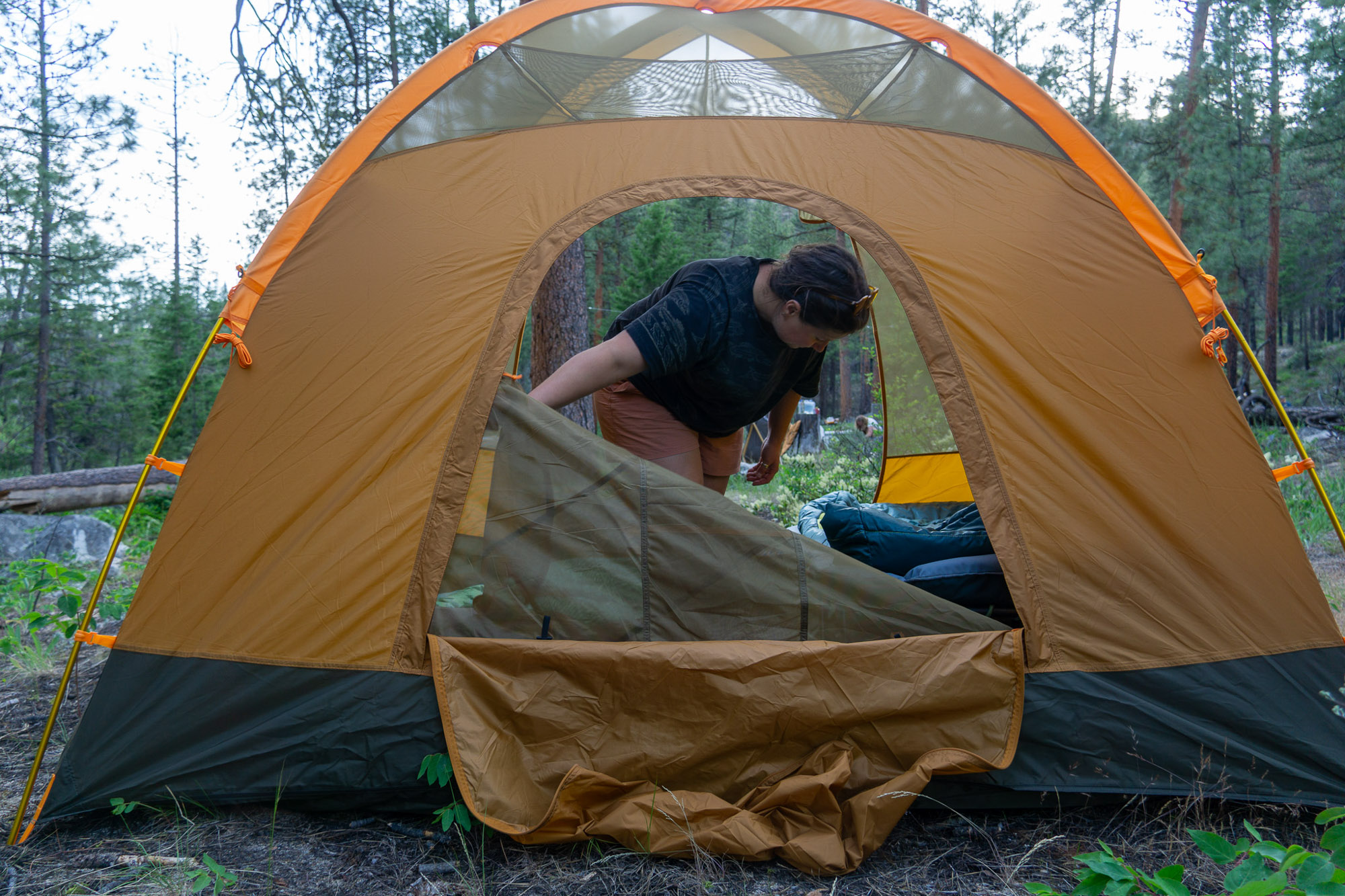
The REI Base Camp offers superior rain protection because its rainfly extends all the way to the ground, whereas the North Face Wawona's fly leaves the lower tent body more exposed. When the sky opened up on day 12 of our test, the Base Camp stayed bone-dry inside. The full-length fly creates a protective "envelope," and the massive vestibules provide a staging area for wet boots and muddy dogs without bringing the mess inside.
2. Structural Integrity: The 5-Pole Dome
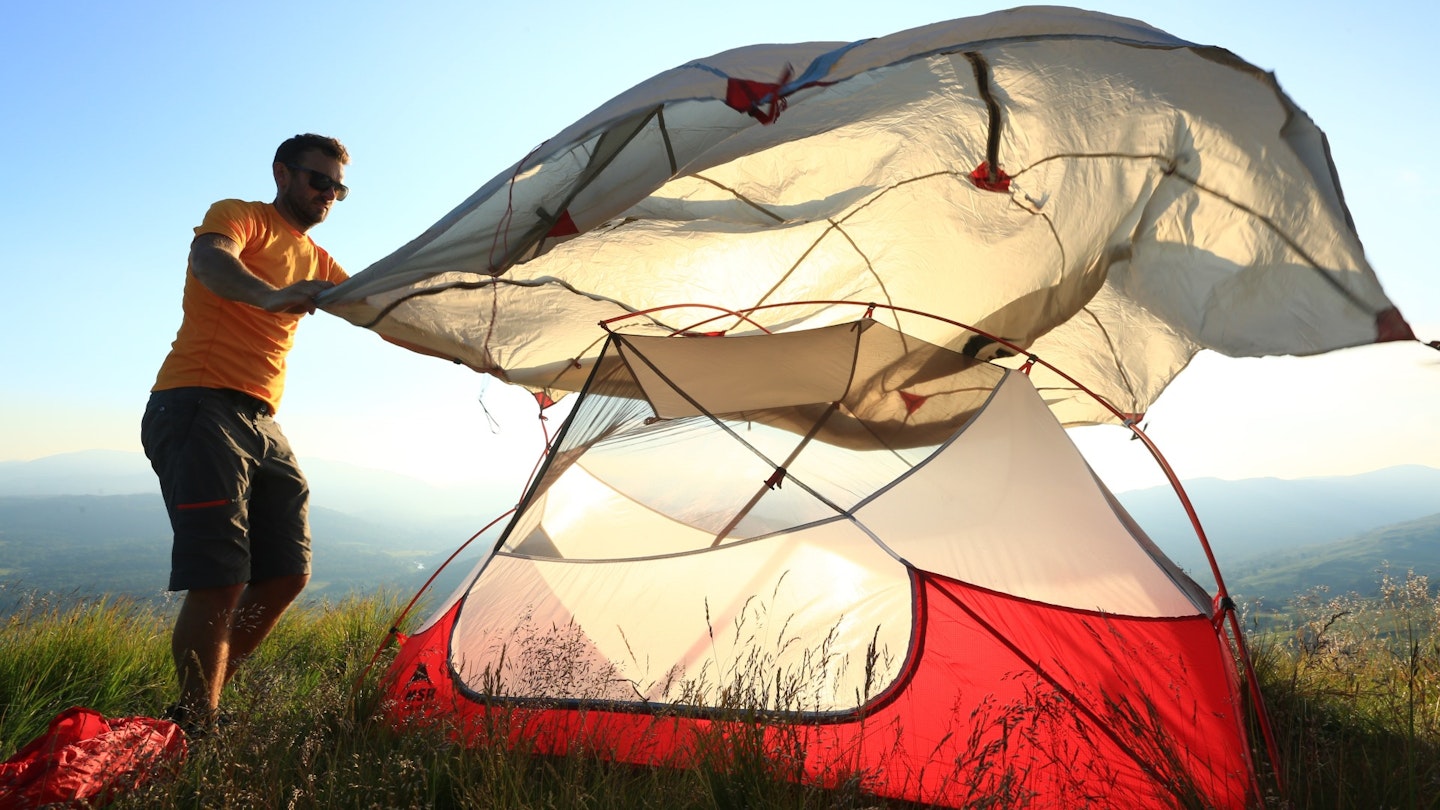
Most car camping tents use a simple 2-pole X-frame. It’s easy to set up, but it’s weak against side-loading winds. The Base Camp uses a mountaineering-inspired 5-pole dome structure. By adding more crossover points, the tent gains incredible rigidity.
During our high-wind testing, the Base Camp didn't "pancake" or collapse like cheaper dome tents. It held its shape, meaning the fabric didn't flap loudly, allowing us to actually get some sleep while the world outside was going crazy.
3. Ventilation and 3-Season Plus Capability
What does "3-season plus" actually mean? A standard 3-season tent is mostly mesh. Great for summer, but it lets all your body heat escape when the mercury drops below 40 degrees.
The REI Co-op Base Camp differs from standard 3-season models by offering enhanced cold-weather protection through zippered fabric panels over mesh vents. In the Eastern Sierra, we’d leave the vents open during the day to prevent condensation, then zip the fabric panels shut at night to trap warm air. It effectively turns the tent into a cozy cabin.
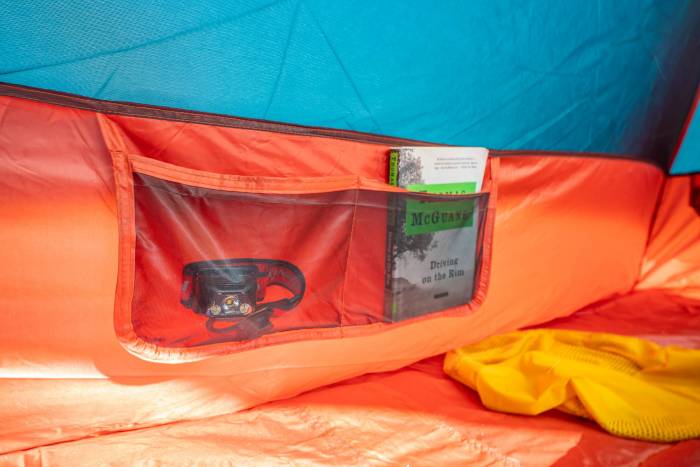
Organizationally, this tent is a masterclass. The REI Base Camp 6-person model features 14 integrated interior storage pockets, significantly higher than the industry average for car camping tents. There’s a pocket for everything—headlamps, snacks, smartphones, and that book you’ve been meaning to finish.
Performance Evaluation
Weather Protection and Wind Resistance
In terms of pure "weatherproofing," the Base Camp is in a league of its own. We experienced 30+ mph gusts that would have snapped fiberglass poles. The aluminum poles and multiple guy-out points kept the tent anchored and silent. The DWR (Durable Water Repellent) coating on the fly beaded water perfectly, and even after 30 days of sun exposure, we saw no signs of UV degradation.
Livability and Comfort
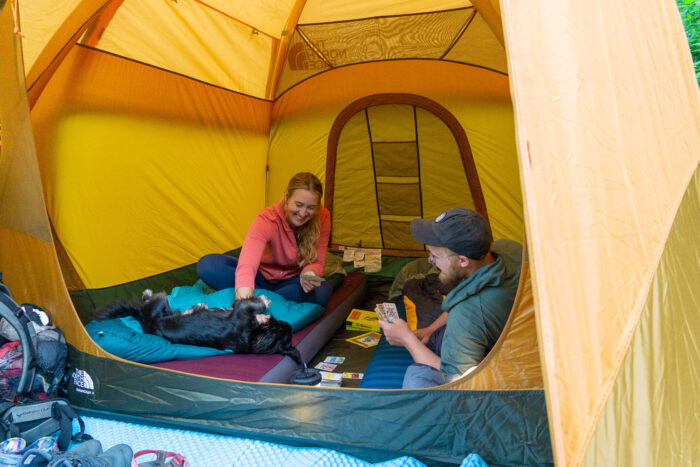
The 6-person model boasts a 74-inch peak height. I’m 6'1", and I could comfortably stand up to change my clothes. The near-vertical walls mean you don't feel like the ceiling is closing in on you when you're near the edges. It feels cavernous, especially when compared to more tapered "plus" tents.
Setup and Ease of Use
Despite the 5-pole design, setup is surprisingly intuitive. REI uses a color-coded pole system and "dead-end" pole sleeves, which means one person can realistically pitch this tent alone in about 10-15 minutes. The stakes provided are actually high-quality aluminum J-stakes, not the flimsy steel "candy canes" you usually get.
Comparison: REI Base Camp vs. The North Face Wawona vs. Nemo Aurora
If you’re shopping for wind resistant family tents, these are likely the three on your shortlist. Here’s how they stack up:
| Feature | REI Base Camp 6 | North Face Wawona 6 | Nemo Aurora Highrise 6 |
|---|---|---|---|
| Best For | 4-Season/High Wind | Massive Vestibule/Fair Weather | Interior Room/Vertical Walls |
| Rain Protection | Excellent (Full Fly) | Average (Partial Fly) | Good (Full Fly) |
| Stability | 5-Pole (Top Tier) | 3-Pole (Average) | 4-Pole (Good) |
| Price | $549 | $500 | $600 |
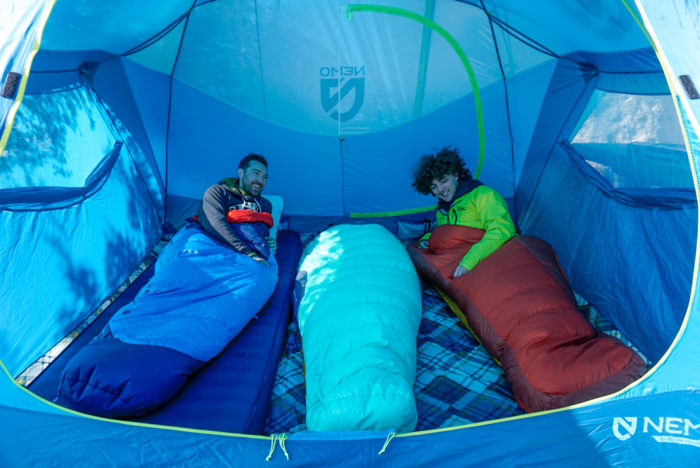
The North Face Wawona is a fan favorite because of its massive "garage" vestibule. It's great for hanging out in the shade, but in a heavy storm, that open front and the partial rainfly on the tent body become liabilities. The Nemo Aurora Highrise has the best interior volume with its steep walls, but it lacks the heavy-duty 150D floor of the Base Camp.
Buyer’s Guide: What to Look for in a Weatherproof Car Camping Tent
When you're ready to drop $500 on a tent, look for these "pro-level" specs:
- Fabric Denier (D): This measures the weight/thickness of the threads. The 150D floor on the Base Camp is the gold standard for car camping. Most "lightweight" tents use 68D or 75D, which requires a footprint to prevent punctures.
- Pole Materials: Always choose aluminum over fiberglass. Aluminum can flex under wind pressure without shattering. Fiberglass is prone to snapping, which can then rip through your tent fabric.
- Guy-out Points: A truly weatherproof tent should have multiple reinforced loops on the rainfly to attach extra cord. In high winds, "guying out" the tent is the only way to prevent structural failure.
- Zipper Quality: Look for YKK zippers. There is nothing worse than a jammed zipper at 3 AM when you need to make a bathroom run in the rain.
Verdict: Should You Buy the REI Base Camp?
After 30 days of living out of this tent, my verdict is clear:
Buy it if:
- You frequently camp in "shoulder seasons" (Early Spring/Late Fall).
- Your camping destinations are prone to high winds (High desert, beaches, ridge tops).
- You want a tent that will last 10+ years of heavy use.
- You value organization and "livability" features like the 14-pocket system.
Skip it if:
- You only camp in the heat of summer in dry climates (it might be overkill and run a bit warm).
- You are a gram-counter who needs a tent that can double for backpacking.
- You are on a tight budget—there are cheaper options if you only camp twice a year.
The REI Co-op Base Camp is a rare piece of gear that lives up to its name. It isn't just a tent; it’s a base of operations. It’s the kind of shelter that turns a "miserable" trip into a "memorable" one because you’re the only one in the campground whose tent is still standing when the storm clears.
FAQ
Is the REI Base Camp a 4-season tent? Technically, it is a "3-season plus." While it is much stronger than a standard tent and can handle light snow loads and freezing temps, it is not designed for extreme alpine environments or heavy, wet snow accumulations like a true 4-season mountaineering tent.
Do I need a footprint for the Base Camp? While the 150D floor is incredibly tough (as proven by our "100-yard drag" test), I still recommend a footprint. It protects the waterproof coating from abrasion and makes packing up a muddy tent much easier.
Can one person set up the 6-person model? Yes. Thanks to the "dead-end" pole sleeves and color-coded webbing, I was able to pitch the 6-person model solo in about 12 minutes. However, having a second person makes it much easier to throw the heavy rainfly over the top.
Conclusion
Choosing a weatherproof tent comes down to trusting your gear when the conditions turn sour. The REI Co-op Base Camp earned my trust in the Eastern Sierra. From its "fortress-like" 5-pole dome to its "clutch" organizational pockets, it’s a masterclass in car camping design. If you're ready to stop worrying about the weather forecast and start enjoying the wild, this is the tent to get you there.