Quick Facts
- Top Overall Performer: The Mountain Hardwear Trango 3 remains the industry gold standard for basecamp stability, featuring a five-pole architecture that laughs at 50+ mph gusts.
- Maximum Wind Resistance: For sheer aerodynamic efficiency, tunnel tents like the Hilleberg Nammatj 3 can withstand linear winds up to 70 mph when properly guyed out, outperforming most dome designs which stabilize at 50 mph.
- The Weight-to-Strength King: The Samaya 2.5 utilizes Dyneema Composite Fabric to deliver a mountaineering shelter that weighs a mere 3 lbs 12 oz while maintaining expedition-level integrity.
- Technical Minimums: For 2026, a true high-wind shelter requires at least 10mm poles and a 70D+ fly material to prevent fabric shredding and structural collapse in extreme winter environments.
Introduction: The Reality of High-Wind Winter Camping
I’ve spent nights on the frozen flanks of Mt. Baker where the wind doesn't just howl—it screams. There is a specific, visceral type of anxiety that sets in when you’re huddled in a sleeping bag, watching the windward wall of your tent flex six inches toward your face under the weight of a 50-mph gust. In those moments, you aren't thinking about the price tag or the color of the fabric. You are thinking about the pole architecture, the denier of the fly, and whether your anchors will hold until sunrise.
Mastering winter camping in 2026 isn't just about staying warm; it’s about choosing a "bombproof" shelter that can handle the dual assault of heavy snow loads and erratic high-altitude winds. Whether you’re planning a technical alpine ascent or setting up a long-term winter basecamp, your tent is your only line of defense against an environment that is fundamentally indifferent to your survival. After testing over 25 different shelters in some of the most unforgiving conditions in North America, I’ve narrowed down the field to the absolute best 4-season tents for high-wind scenarios.
The Short List: Top Picks for 2026
Before we dive into the technical "why," here is the "what." These four tents represent the pinnacle of current shelter technology, categorized by their specific strengths in the field.
| Tent Model | Best For | Max Wind Rating | Weight | Approx. Price |
|---|---|---|---|---|
| Mountain Hardwear Trango 3 | Overall Expedition Stability | 50+ mph | 11 lbs 5 oz | $950 |
| Hilleberg Nammatj 3 | Extreme Linear Winds | 70 mph | 7 lbs 8 oz | $1,050 |
| Samaya 2.5 | Ultralight Mountaineering | 45-50 mph | 3 lbs 12 oz | $1,200 |
| REI Co-op Arete ASL 2 | Budget/Shoulder Season | 35-40 mph | 6 lbs 5 oz | $449 |
1. Best Overall Expedition Shelter: Mountain Hardwear Trango 3
If I’m headed into a region where the weather forecast looks like a disaster movie, I’m bringing the Trango 3. This isn't a tent you carry if you’re counting every gram, but it is the tent you want when the sky falls. Its five-pole architecture creates a series of intersection points that turn the structure into a rigid exoskeleton.
With 48 square feet of interior space, it’s a palace for two and a comfortable fortress for three. During our testing on Mt. Baker, we subjected the Trango to 24-hour snowfall measured in feet, not inches. While other tents began to "pancake" under the weight, the Trango’s steep walls and reinforced pole structure shed the snow effortlessly.
- Pros: Incredible internal volume; reinforced tension shelves; virtually indestructible in 50+ mph gusts.
- Cons: Heavy; requires a significant footprint for setup.
Check Price on Mountain Hardwear →
2. Best for Extreme Gusts (Tunnel Design): Hilleberg Nammatj 3
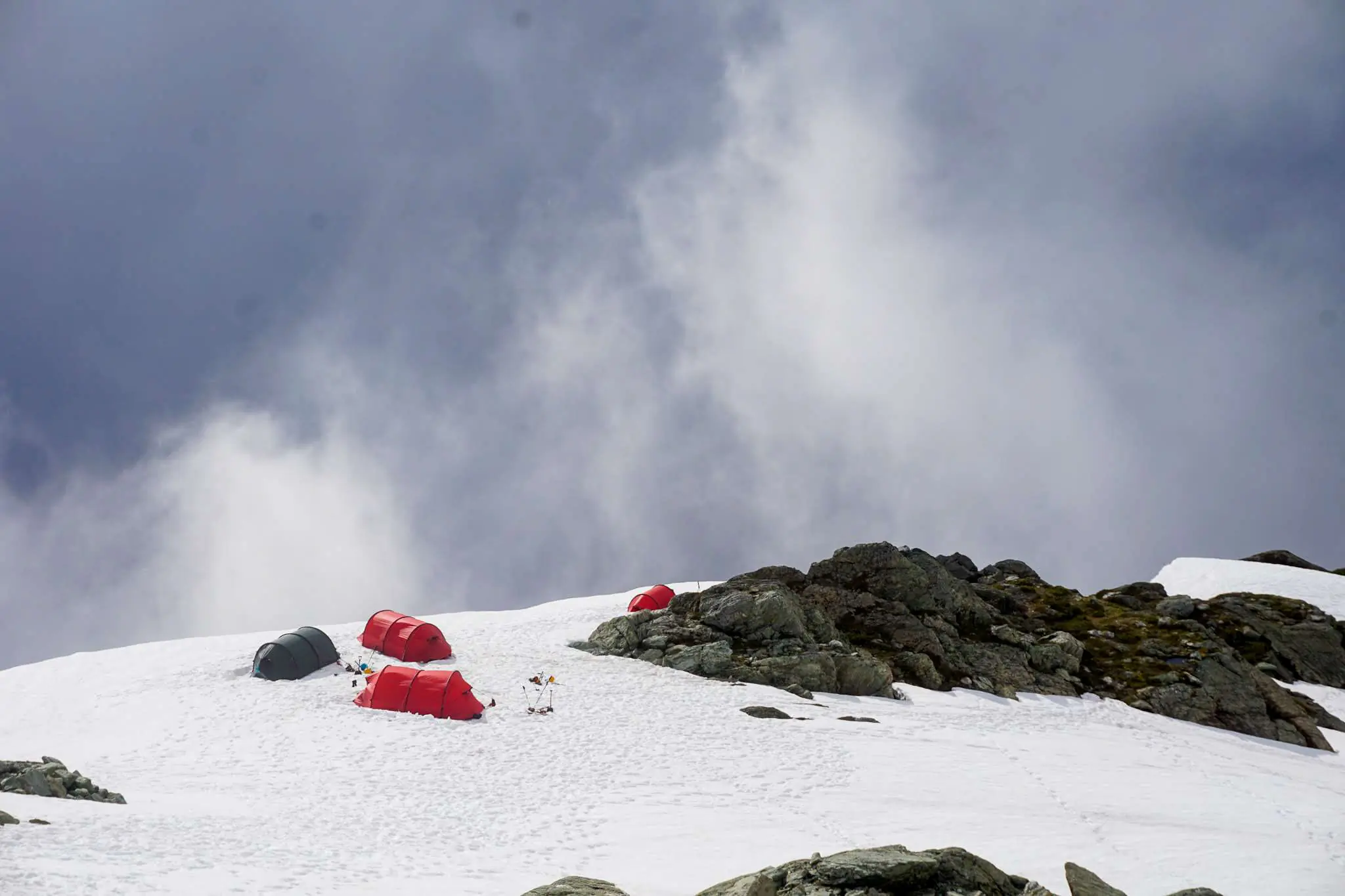
There is a long-standing debate in the mountaineering community: Tunnel vs. Dome. While dome tents (like the Trango) excel at handling snow loads from any direction, tunnel tents are the undisputed kings of aerodynamic efficiency. The Hilleberg Nammatj 3 is built with Kerlon 1800 fabric—a high-tenacity ripstop nylon with a 40lb tear strength—and 10mm DAC poles.
When you orient the Nammatj correctly (narrow end into the wind) and use all the guy-out points, it can withstand winds up to 70 mph. It feels less like a tent and more like a wing pinned to the ground. It’s the preferred choice for polar expeditions and high-latitude traverses where the wind is constant and directional.
- Why it wins: The tear-resistant silicone-coated fabric doesn't just block wind; it vibrates less, which means you might actually get some sleep during a storm.
- Setup Tip: Always carry extra snow stakes for the vestibule; the integrity of a tunnel tent relies entirely on the tension between the front and rear anchors.
3. Best Ultralight Mountaineering Tent: Samaya 2.5
In the past, "4-season" meant "heavy." The Samaya 2.5 has shattered that convention. By utilizing Dyneema Composite Fabric (DCF) for the flooring and a proprietary 3-layer laminated fabric for the walls, they’ve created a single-wall tent that weighs less than four pounds but offers more protection than most mid-weight 3-season tents.
This is a specialized tool for fast-and-light alpine missions. It’s a single-wall design, meaning it sacrifices some breathability for massive weight savings. However, in high-wind environments, the Samaya’s strength-to-weight ratio is unparalleled. We tested this on exposed ridges where every ounce felt like a pound, and the Samaya’s minimalist profile allowed it to tuck into small, protected ledges that a larger Trango simply couldn't fit into.
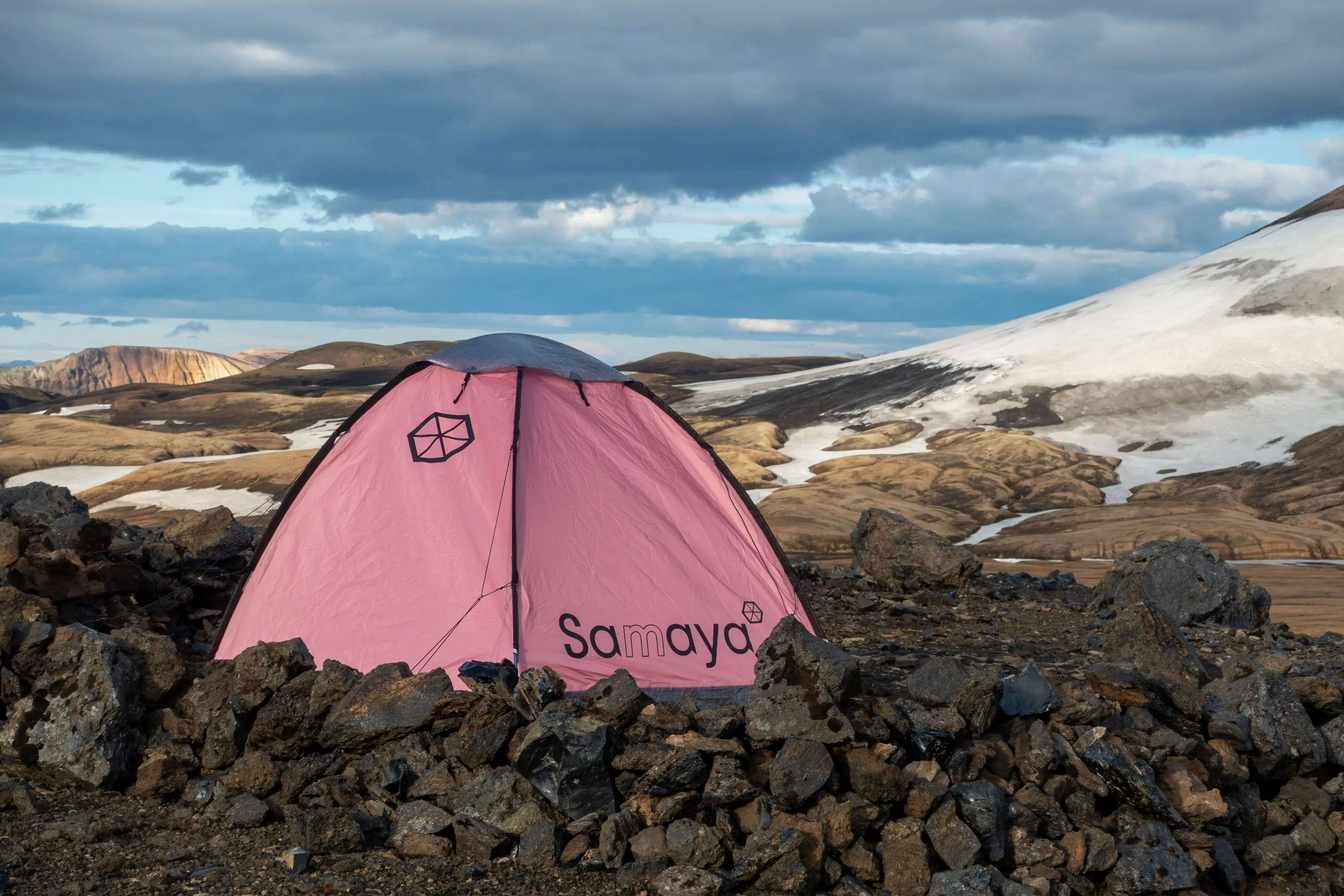
- Performance Note: While it handles wind remarkably well due to its low profile, the Samaya requires active management of condensation in sub-zero temps.
4. Best Budget 4-Season Crossover: REI Co-op Arete ASL 2
For those just dipping their toes into winter camping or focusing on "shoulder season" adventures, the REI Arete ASL 2 is a steal. At $449, it provides a 4-season structure—meaning more pole intersections and less mesh—at a mid-tier price point.
While I wouldn't take this to the summit of Denali, it is perfect for winter camping in the Sierras or the White Mountains where gusts peak at 35-40 mph. It uses a 3-pole design that provides significantly more rigidity than a standard backpacking tent without the 11-pound penalty of a full expedition shelter.
Technical Deep Dive: What Makes a Tent Windproof?
When you’re paying $800+ for a shelter, you’re paying for engineering, not just fabric. Here is the technical breakdown of what keeps a tent standing when the environment is trying to flatten it.
Geometry: Dome vs. Tunnel vs. Pyramid
The shape of your tent dictates how it sheds energy.
- Dome Tents: These are inherently stable because the poles cross each other at multiple points, creating a rigid "birdcage" effect. They are the best choice for variable winds and heavy snow loading.
- Tunnel Tents: These outperform dome styles in linear, high-velocity winds. Because they have a smaller cross-section, the wind flows over them rather than pushing against them. However, if the wind shifts 90 degrees and hits the side of a tunnel tent, the stress on the poles increases exponentially.
- Pyramid (Mids): Great for shedding snow, but they rely entirely on a single center pole and a perfect pitch. One pulled stake can lead to a total collapse.
Pole Architecture and Materials
The "bones" of your tent are usually made by DAC (Dongah Aluminum Corp). For high-wind winter camping, look for DAC NSL or NFL aluminum poles. The diameter matters: mid-tier tents use 8.5mm to 9mm poles, while true expedition shelters like the Trango utilize 10mm+ poles. More importantly, look at the "intersection points"—every place two poles cross is a point of reinforcement that prevents the tent from racking (leaning sideways).
Double-Wall vs. Single-Wall
- Double-Wall: Consists of a breathable inner tent and a waterproof outer fly. This is the gold standard for preventing condensation and providing a thermal buffer.
- Single-Wall: One layer of waterproof/breathable fabric. These are lighter and faster to pitch in a storm, but they are prone to internal frosting in cold, humid conditions.
Pro Tip: In high winds, a single-wall tent can actually be quieter. Without a fly sheet to flap against the inner tent, the "drumming" noise is significantly reduced, which can be the difference between getting four hours of sleep and zero.
Essential Setup Techniques for High Winds
The best tent in the world will fail if it's pitched poorly. When the wind picks up, your setup technique becomes as critical as the gear itself.
- Strategic Positioning: Your first line of defense is the landscape. Look for natural windbreaks like stands of trees or large boulders. If you’re on an exposed glacier, you’ll need to build a snow wall (quinzhee style) on the windward side of your tent.
- Orientation: Always orient the narrowest, lowest profile of the tent into the prevailing wind. For tunnel tents, this is the rear; for domes, it’s usually the foot end.
- Deadman Anchors: Standard stakes are useless in deep, soft snow. Use "deadman" anchors—bury your stakes, snow shoes, or even stuff sacks filled with snow horizontally at least 12-18 inches deep. Let the snow "set" for 20 minutes before applying tension.
- Guy-line Tensioning: Use high-strength cordage (like 2mm Kelty TripTease) and ensure every guy-out point is utilized. The goal is to distribute the wind's energy across the entire frame rather than letting it focus on a single pole.
How We Tested These Shelters
Our 2026 gear guide is the result of exhaustive field testing. We don't just look at spec sheets in a climate-controlled office. We took these 25+ models to the Coleman Glacier on Mt. Baker, a location notorious for its erratic weather and high-moisture snowfall.
Our testing protocol involves:
- The 24-Hour Load Test: Measuring how much snow accumulates on the roof before the fabric sags or the poles deflect.
- The Gust Test: Using handheld anemometers to track performance in actual 50+ mph gusts. We look for "pole chatter" and fabric resonance.
- The Ergonomic Review: Can you pitch this tent with heavy mitts on? If the pole sleeves are too tight or the clips are too small, the tent is a liability in a real winter storm.
FAQ: Mastering the Fourth Season
Can a 3-season tent survive a winter storm? Occasionally, yes, but it’s a massive risk. 3-season tents have more mesh (which lets in spindrift snow) and thinner poles that can snap under the weight of a heavy snow load. If you’re expecting more than an inch of snow or winds over 25 mph, a 4-season tent is a safety requirement, not an luxury.
How do I prevent condensation in high winds? In high winds, you are tempted to close every vent to stay warm. Don't. You need airflow to move your exhaled moisture out of the tent. Open the leeward (downwind) vents. If you see frost forming on the inside, you need more ventilation.
Are single-wall tents safe for high-altitude expeditions? Yes, and in many cases, they are preferred for technical climbing because they have a smaller footprint and can be pitched on narrow ledges. However, they require more experience to manage moisture and are generally less comfortable for multi-day basecamp stays.
Final Verdict: Choosing Your Winter Stronghold
Choosing the right 4-season tent comes down to your objective. If you are setting up a Basecamp where weight is secondary to comfort and absolute safety, the Mountain Hardwear Trango 3 is your winner. It is a time-tested fortress that has protected thousands of climbers on the world’s highest peaks.
If you are a High-Latitude Explorer facing constant, high-velocity winds on the tundra or ice caps, the aerodynamic prowess of the Hilleberg Nammatj 3 is unbeatable. And for the Alpine Specialist moving fast where every gram is a burden, the Samaya 2.5 represents the future of ultralight mountain protection.
Winter camping is a game of margins. Don't let your shelter be the weak link. Invest in the right architecture, master your anchors, and you’ll find that the "worst" weather often leads to the most incredible experiences.
Ready to gear up? Check out our latest Winter Layering Guide to ensure your clothing is as bombproof as your shelter.