Quick Facts
- The Catalyst: The Department of Homeland Security (DHS) is currently blasting rock within the Coronado National Memorial to secure aggregate for concrete, a move that bypasses nearly all federal environmental protections.
- The Legal Loophole: A 1996 Clinton-era law and the 2005 REAL ID Act grant the DHS Secretary "sole discretion" to waive laws like the Endangered Species Act to expedite border barrier construction.
- Ecological Impact: The construction creates a 200-foot-wide "death zone" that severs the Sky Islands ecosystem, a critical migration corridor for the northernmost jaguar population in the world.
- Conservation Loss: This industrial expansion risks nullifying more than 53 years of federal jaguar recovery and conservation efforts in the American Southwest.
The Sound of Destruction: Blasting in Coronado National Memorial
High above the San Pedro Valley, where the Huachuca Mountains meet the sky, a sound now echoes that was never meant to be heard in a National Memorial: the rhythmic, earth-shaking thud of industrial blasting. For decades, the Coronado National Memorial has served as a sanctuary for those seeking the profound silence of the High Sonoran Desert. Today, that silence is being systematically dismantled.
The Department of Homeland Security has initiated large-scale blasting operations within the memorial’s boundaries. The objective is utilitarian and jarring: to harvest rock debris for the massive amounts of concrete required to anchor a 30-foot-tall steel bollard wall. This specific project spans 27 miles of once-pristine borderlands, turning a landscape defined by its rugged beauty into an active quarry.
Key Insight: Why is this happening? DHS is blasting in Coronado National Memorial to harvest rock debris for concrete used in building 27 miles of border wall, citing a 1996 law to bypass environmental regulations.
To stand at Montezuma Pass today is to witness a profound shift in land management. Where visitors once looked south toward Mexico to contemplate the shared history of the 1540 Coronado Expedition, they now see heavy machinery chewing through ancient limestone. The industrialization of this landscape isn't just an aesthetic tragedy; it is a structural one. The debris harvested here is the literal foundation of a barrier that aims to end the fluid movement of life that has characterized these mountains for millennia.
The Legal Loophole: How DHS Bypasses the Endangered Species Act
In the American legal system, few individuals hold the power to unilaterally set aside the laws of the land. However, in the realm of border security, a little-known legislative relic has granted the DHS Secretary near-monarchical authority over public lands.
This authority stems from Section 102 of the Illegal Immigration Reform and Immigrant Responsibility Act of 1996 (IIRIRA), which was later expanded by the REAL ID Act of 2005. These laws allow the Secretary of Homeland Security to waive any and all legal requirements that might impede the "expeditious construction" of border barriers. This includes the National Environmental Policy Act (NEPA), the Clean Water Act, and, most critically for the wildlife of the Southwest, the Endangered Species Act.
Legal Reality Check Under a 1996 Clinton-era law, the DHS Secretary has the sole discretion to waive all legal requirements, including the Endangered Species Act, to expedite border barrier construction.
By invoking these waivers, DHS can bypass the standard environmental impact studies that would otherwise take years to complete. There is no public comment period, no requirement to study the long-term effects on local aquifers, and no obligation to consult with wildlife biologists about the survival of threatened species. For the first time in modern American history, a single federal agency has the power to ignore the very laws designed to protect our collective natural heritage, effectively operating in a legal vacuum across some of our most sensitive ecosystems.
The Jaguar’s Last Stand: Habitat Fragmentation in the Sky Islands
The Arizona borderlands are part of the "Sky Islands"—a series of mountain ranges that rise out of the desert like islands from a sea. These mountains serve as biological bridges, allowing species from the Sierra Madre in Mexico to migrate north into the Rocky Mountains. Among these travelers, none is more iconic—or more threatened—than the jaguar (Panthera onca).
For the last half-century, conservationists have worked tirelessly to welcome the jaguar back to its ancestral home in the United States. Jaguars are solitary, wide-ranging cats that require vast, uninterrupted territories to find mates and hunt. The Coronado and the neighboring San Rafael Valley represent one of the few viable "gateways" for jaguars moving north from breeding populations in Sonora, Mexico.
The Biological Crisis The border wall construction threatens endangered jaguars by fracturing migration routes and destroying the natural connectivity of the Sky Islands ecosystem in southern Arizona.
The current Arizona border wall construction risks nullifying over 53 years of federal jaguar conservation efforts in the United States. Biologists warn that once the steel bollards are set in concrete, the genetic flow between the northern and southern populations will be severed. Without the ability for new individuals to move north, the few jaguars currently inhabiting the mountains of Southern Arizona—such as "Sombra" or "El Jefe"—may be the last of their kind to roam the American Southwest. We aren't just building a wall; we are building an extinction event for the world's third-largest cat in its northernmost range.
From Wilderness to 'Death Zone': Ecological Consequences
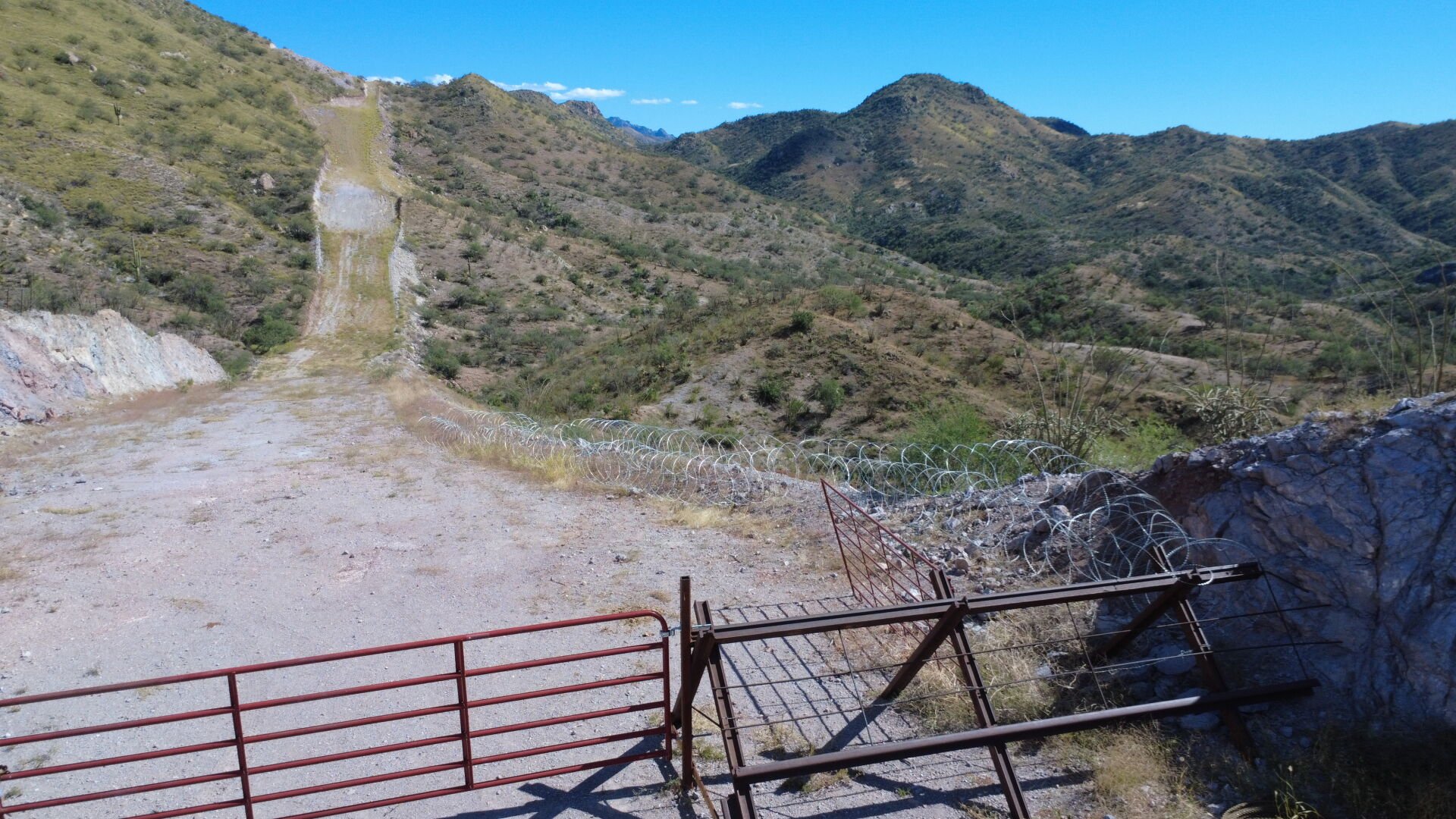
The environmental impact of the border barrier extends far beyond the footprint of the steel bollards themselves. To facilitate construction and patrol, the DHS implements what ecologists have grimly dubbed the "death zone." This is a 200-foot-wide corridor cleared of all vegetation, running parallel to the wall on the U.S. side.
Planned double-wall systems will create a 200-foot-wide clear-cut 'death zone' north of the border, effectively trapping wildlife between high-security barriers. This zone is a biological vacuum. Any animal that manages to find a gap in the fence or navigate around a barrier suddenly finds itself in an exposed, floodlit wasteland with no cover from predators or the searing desert sun.
The secondary impacts are equally devastating:
- Stadium Lighting: High-intensity LED arrays remain lit throughout the night, disrupting the circadian rhythms of nocturnal hunters and migratory birds.
- Entanglement Risks: Razor-sharp concertina wire, often laid in multiple tiers at ground level, acts as a lethal trap for deer, javelina, and larger predators.
- Noise Pollution: The constant drone of patrol vehicles and surveillance technology creates a sensory barrier that many animals are unwilling to cross, even if a physical opening exists.
Affected Species and Barriers
The following table highlights the specific threats posed by different wall infrastructures to the diverse residents of the Arizona borderlands.
| Impacted Species | Barrier Type | Ecological Consequence |
|---|---|---|
| Jaguar & Ocelot | 30ft Steel Bollards | Complete cessation of north-south genetic migration. |
| Sonoran Pronghorn | Double-Wall System | Total loss of access to seasonal foraging grounds. |
| Desert Tortoise | Solid Concrete Plinth | Inability to cross even "permeable" sections due to base height. |
| Pygmy Owl | Low-Altitude Lighting | Disruption of flight paths and increased predation risk. |
| Black Bear | Concertina Wire | Severe injury or death during attempts to scale barriers. |
Affected Sites: More Than Just a Wall
While the Coronado National Memorial has been the site of recent blasting, it is merely one piece of a much larger puzzle of destruction. These borderlands are a mosaic of protected lands, each now facing its own existential crisis.
Organ Pipe Cactus National Monument
Further west, this UNESCO Biosphere Reserve has seen its ancient saguaros and organ pipe cacti cleared to make way for the wall. The construction has also threatened the Quitobaquito Springs, a sacred site for the Hia C-ed O'odham people and a critical water source for the endangered desert pupfish. The diversion of water for concrete mixing has caused the springs' flow to drop to historic lows.
Pajarita Wilderness and the San Rafael Valley
The San Rafael Valley is a sea of grass, one of the few remaining short-grass prairies in the Southwest. The industrialization of this pristine grassland with "stadium lighting" and high-security roads has permanently altered its character. For those who once came here to experience the "Old West" or to birdwatch in the Pajarita Wilderness, the landscape is now unrecognizable, dominated by a towering steel monolith that stretches to the horizon.
The $1.49 Billion Contract: Who is Building the Wall?
The scale of this project is matched only by its price tag. A significant portion of the construction in Arizona has been awarded to Fisher Sand & Gravel, a firm that secured a $1.49 billion contract. This award was controversial from the start, as the firm had faced previous environmental violations and engineering concerns.
The construction process involves massive amounts of groundwater extraction to suppress dust and mix concrete—a precarious practice in a region currently suffering from a multi-decadal "megadrought." In many cases, the DHS is drawing from the same aquifers that local ranchers and wildlife depend on for survival. The result is a project that is not only ecologically destructive in its final form but also in its very creation.
Summary of the Crisis: A Borderland at a Crossroads
The conflict over the Arizona borderlands is often framed as a simple choice between national security and environmental preservation. However, a deeper look reveals a far more complex and tragic trade-off. By utilizing environmental waivers to bypass decades of established law, we are sacrificing the very biological heritage that makes the American West unique.
The blasting in Coronado National Memorial and the creation of "death zones" across the Sky Islands represent a permanent shift in our relationship with the land. Once these migration routes are severed and these ecosystems are fractured, they cannot be easily mended. We are witnessing the dismantling of half a century of conservation progress in the span of a few years. As the dust settles from the latest round of blasting, the question remains: what will be left of our borderlands for the next generation to inherit?
FAQ
What are DHS environmental waivers? These are legal mechanisms, granted by the 1996 IIRIRA and 2005 REAL ID Act, that allow the Secretary of Homeland Security to bypass all federal, state, and local laws—including the Endangered Species Act—to speed up the construction of border barriers.
Can jaguars jump over the border wall? No. The current 30-foot-tall steel bollard walls are designed to be unclimbable for large mammals. Additionally, the concrete foundation prevents animals from digging under, and the 200-foot-wide clear-cut "death zone" discourages any approach.
Why is blasting happening in a National Memorial? DHS is blasting in the Coronado National Memorial to harvest limestone and other rock debris. This material is then crushed and used as aggregate for the concrete needed to secure the wall's bollards in the rugged mountain terrain.
Take Action
The future of the Arizona borderlands depends on public awareness and advocacy. To learn more about how you can support the preservation of the Sky Islands and the protection of the American jaguar, visit the Center for Biological Diversity's borderlands campaign.