Quick Facts
- Best Overall Hard SUP: The Surftech Lido Utility Armor claims the top spot for 2025, blending a 350-pound weight capacity with a high-performance glide that suits both novices and experts.
- Best for Beginners: The Isle Cruiser 2 is the definitive choice for those finding their sea legs, featuring low-sitting side rails that lower the rider's center of gravity.
- Top Value Pick: The Tahe Beach Performer offers the best "bang for your buck," delivering a premium feel and durable construction at a price point significantly lower than its carbon-fiber competitors.
- The Weight Factor: Portability remains the biggest trade-off for rigid boards. High-performance models like the Isle Cruiser 2 are lightweight, whereas budget-friendly options like the Pelican Flow 106 can weigh up to 46 pounds—nearly double the weight of elite models.
For the purist, nothing compares to the tactile response and effortless glide of a rigid stand-up paddle board. While the convenience of inflatables has dominated the market in recent years, 2025 marks a return to form for hardshell SUPs. Our team of critics and enthusiasts spent months evaluating the latest releases to determine which boards actually deserve a spot in your garage.
Transitioning from an inflatable to a rigid board is like moving from a touring sedan to a precision-engineered sports car. You trade portability for immediate power transfer and a hull shape that can be far more sophisticated than a "balloon" structure. In our 2025 testing cycle, we prioritized objective performance metrics to cut through the marketing noise.
How We Tested: Our Scientific Methodology
To ensure an authoritative ranking, we moved away from subjective "feel" and toward a weighted scoring system. Each board was subjected to head-to-head testing across lakes, rivers, and coastal inlets. Our enthusiasts put every board through rigorous drills to measure efficiency and resilience.
We evaluated each board based on five critical pillars:
- Glide Performance (35%): The most critical factor for a rigid SUP. We measured how many strokes were required to cover 100 meters and how long the board maintained momentum after paddling ceased.
- Stability (25%): We tested "primary stability" (how it feels when standing still) and "secondary stability" (how it handles chop and lateral waves).
- Maneuverability (15%): We conducted pivot turn drills and obstacle courses to see how quickly each hull responds to paddle input.
- Ease of Transport (15%): This includes the weight of the board, the ergonomics of the carry handle, and how manageable it is for a single person to load onto a roof rack.
- Construction Quality (10%): We analyzed the materials—from Utility Armor to Pine-reinforced decks—to assess long-term durability against dings and UV damage.
Comparison Table: 2025 Top Tier Hard SUPs
| Model | Category | Length | Weight | Max Capacity | Glide Score (Out of 10) |
|---|---|---|---|---|---|
| Surftech Lido | Best Overall | 10'6" / 11'6" | 28 lbs | 350 lbs | 9.2 |
| Isle Cruiser 2 | Best Beginner | 10'5" | 24 lbs | 235 lbs | 8.1 |
| Tahe Beach Performer | Best Value | 10'6" | 32 lbs | 200 lbs | 8.4 |
| Pelican Flow 106 | Best Budget | 10'6" | 46 lbs | 230 lbs | 6.5 |
| Starboard Gen LT | Best Touring | 12'6" | 27 lbs | 210 lbs | 9.8 |

Detailed Reviews of the Best Rigid SUPs
1. Surftech Lido Utility Armor – Best Overall for 2025
The Surftech Lido is a masterclass in versatility. What set it apart in our testing was its "Utility Armor" construction—a high-density thermoformed plastic skin that wraps an EPS core. This makes the board virtually bulletproof against rocky shorelines and dock dings without the excessive weight usually associated with plastic boards.
The Lido offers exceptional stability, particularly for larger paddlers or those carrying gear, thanks to its 350-pound carrying capacity. On the water, it feels nimble rather than sluggish. It tracks straight and carries its momentum beautifully, making it as suitable for a five-mile fitness paddle as it is for a casual afternoon at the lake.
- Pros: Incredible durability; high weight ceiling; superior glide-to-stability ratio.
- Cons: Higher price point than entry-level hardshells.
Scorecard:
- Glide: 9.2/10
- Stability: 9.5/10
- Maneuverability: 8.5/10
2. Isle Cruiser 2 – Top Pick for Beginner Paddlers
For those new to the sport, the Isle Cruiser 2 is arguably the most forgiving rigid board on the market. Isle utilized a clever design trick: the side rails sit slightly lower than the standing area, effectively lowering your center of gravity. This makes the board feel significantly wider and more stable than its 32-inch width suggests.
We were particularly impressed by the "Pop-Out" carry handle, which retracts into the board when not in use. At only 24 pounds, it is one of the lightest boards in our roundup, making the transition from the car to the water a breeze for solo paddlers.
- Pros: Lightweight and easy to carry; ultra-stable rail design; soft EVA deck pad.
- Cons: Lower weight capacity (235 lbs) limits gear or pet passengers.
Scorecard:
- Glide: 8.1/10
- Stability: 9.8/10
- Maneuverability: 8.0/10
3. Tahe Beach Performer – Best Bang for the Buck
Formerly known under the BIC Sport brand, the Tahe Beach Performer remains the gold standard for value. It utilizes an "Ace-Tec" construction—a composite material that is much lighter than polyethylene but tougher than traditional fiberglass.
During our testing, the Performer showcased a solid glide that outperformed several boards twice its price. While its weight limit of 200 lbs is a consideration for larger riders, its surf-inspired longboard shape makes it surprisingly capable in small waves, offering a dual-purpose functionality that is rare at this price point.
- Pros: Affordable; impact-resistant; excellent cross-over performance for surf.
- Cons: Strict weight limit; basic aesthetics.
Scorecard:
- Glide: 8.4/10
- Stability: 8.2/10
- Maneuverability: 8.8/10
4. Pelican Flow 106 – Best Bargain Buy
The Pelican Flow 106 is the "rugged pickup truck" of the SUP world. It is built from twin-sheet thermoformed polyethylene, meaning it can survive being dragged over gravel or dropped in the parking lot.
However, there is a literal weight to this durability. At 46 pounds, the Pelican is nearly double the weight of the Isle Cruiser 2. While it represents an incredible bargain for those on a tight budget, the weight significantly impacts its ease of transport and its agility on the water. It feels somewhat "sluggish" in turns but provides a rock-solid platform for yoga or fishing.
- Pros: Lowest price in the category; virtually indestructible.
- Cons: Extremely heavy; difficult to load on high SUVs solo.
5. Starboard Generation LT – Best High-Performance Touring
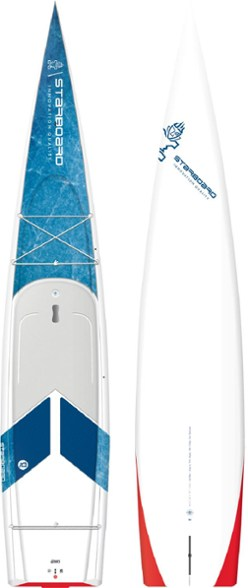
If speed and distance are your goals, the Starboard Generation LT is a precision tool. This board blurs the line between a surf SUP, a racing board, and a touring hull. It features a pine-reinforced standing area for maximum rigidity and a recessed deck pad that keeps the rider closer to the water.
Its displacement-style nose slices through chop rather than riding over it, which is why it earned a near-perfect 9.8 in our Glide score. While the Lido excels in stability, those seeking pure speed will find the Starboard far more rewarding in dynamic currents.
- Pros: Elite-level glide; sophisticated hull design; lightweight.
- Cons: Narrower profile requires more balance skill.
6. SIC Maui TAO Fit AT – Notable Value & Durability
The TAO Fit is designed for those who want a stable, "do-everything" board that can be shared among family members of varying skill levels. Using a fiberglass alternative that mimics the rigidity of carbon but at a fraction of the cost, the TAO Fit is particularly impressive in its ability to track straight even in windy conditions.
Scorecard:
- Glide: 8.8/10
- Stability: 9.0/10
- Maneuverability: 7.5/10
Buyer’s Guide: Choosing Your Rigid SUP
Selecting a hardshell board requires a more technical approach than buying an inflatable. Because you cannot change the shape of the board once it’s built, understanding hull design and volume is paramount.
Hull Types: Planing vs. Displacement
Most of the boards in our "Best Overall" and "Beginner" categories utilize a planing hull. These are flat and wide, designed to ride on top of the water. They are the most stable and maneuverable, making them ideal for casual paddling and surfing.
Conversely, a displacement hull—found on the Starboard Generation—features a pointed nose similar to a kayak or a rowing shell. These are designed to slice through the water. While they feel more "tippy" when standing still, they are vastly superior for fitness and long-distance touring because they don't push a wall of water in front of them.
Volume and Weight Capacity
Volume (measured in liters) determines how much weight a board can support before it begins to sink too deep into the water. If a rider is too heavy for a board’s volume, the board creates excessive drag, making it difficult to paddle.
For a rigid board, you generally want a volume that is at least double your body weight in kilograms for a performance fit, or triple for a stable, "dry" ride. Boards with higher volume are essential for multi-day touring where you might be carrying 40-50 pounds of camping gear.

Storage and Transportation
The Achilles' heel of the rigid board is the logistics. Before purchasing, ensure you have a dedicated space—ideally out of direct sunlight—and a reliable roof rack system. Remember that the Pelican's 46-pound weight might not sound like much in the gym, but lifting it overhead to a roof rack after a tiring two-hour paddle session can be a challenge. Look for integrated storage solutions like bungee systems or M6 inserts if you plan on long day trips.
FAQ
Q: Are hard paddle boards faster than inflatables? A: Generally, yes. Rigid boards can be shaped with sharper rails and more sophisticated hull designs that reduce drag. They also don't "flex" under the rider's weight, ensuring that every ounce of energy from your paddle stroke is converted into forward motion.
Q: How do I repair a ding in a hardshell SUP? A: Most dings can be fixed with a simple UV-cure epoxy resin kit. It is vital to dry the board thoroughly and seal any cracks immediately to prevent the internal foam core from absorbing water, which can lead to "delamination" or permanent weight gain.
Q: Can I use a hard paddle board for river paddling? A: Yes, but with caution. While a board like the Surftech Lido is durable, hard boards are more prone to structural damage if they strike a submerged rock at high speed. For shallow, rocky rivers, an inflatable or a high-durability plastic board like the Pelican is often a safer bet.
Expert Verdict
For the ultimate 2025 experience, the Surftech Lido Utility Armor is the board that offers the least compromise. It manages to provide the "pro" feel of a high-glide hardshell while maintaining the ruggedness of a utility board. However, if your budget is the primary driver, do not overlook the Tahe Beach Performer; it remains the most sophisticated hull you can buy for under $800.
Ready to hit the water? Investing in a quality rigid board is an investment in your technique and your enjoyment of the great outdoors.